

Some catamarans catch your eye with a bold look. Others make you think about the places you could sail to and the life you could enjoy aboard. The FP 48 belongs to that second group. Our complete Fountaine Pajot FP48 catamaran reviews and model guide bring together more information about this new cruising catamaran built in France, in La Rochelle.
Now it is on the shortlist for Multihull of the Year at the British Yachting Awards 2026. At Caribbean Multihulls, we would love to see it receive your support. Not simply because we represent the builder, but because its approach to comfort and sailing makes sense to us.
A place on the Multihull of the Year shortlist
The British Yachting Awards 2026 invite readers to vote across 11 categories. This year’s awards are online-only, and voting closes on 7 November. There is still time to explore the shortlisted boats and have your say.
Our choice is clear, but we encourage you to be curious. An award shortlist is also a chance to discover diverse ideas about life at sea. There is no single perfect cat for every sailor, and comparing approaches is part of the pleasure.
Looking at the nominated boats
You can find the full range of catamarans on the Multihull of the Year shortlist:
- Fountaine Pajot 48
- Leopard 43
- Outremer 48
- Aquila 45
- Balance 502
- Lagoon 47
- Seawing 1270
- Windelo 55 Sport
Why Caribbean Multihulls supports this cat
Of course, choosing a yacht is personal. Some sailors want a lighter boat and more speed. Others put easy handling, generous cabins with private head, and shared meals first. What interests us here is how the different zones work together at anchor or underway, rather than one big feature that takes all the attention.
Nearly 20 years of trust in Fountaine Pajot
We have believed in Fountaine Pajot catamarans for nearly 20 years. During that time, the brand has never disappointed our team. We are proud to represent boats built to help people turn plans for time on the water into something real.
That trust does not mean every new model should escape a careful look. A good boat must answer practical questions:
- Can the crew move around easily?
- Can the person at the helm see forward?
- Does the interior space still work when everyone comes inside?
- Etc.
These are the details that matter after the first excitement of stepping aboard. The latest design follows a familiar direction, but with changes that should become more valuable as you spend time aboard. For us, that is a good reason to pay attention.
A yacht for private cruising or charter
We proudly represent the range for both personal use and charter. The needs are not always the same, but both call for comfortable accommodation, useful storage and a design that gives people room to share the day without being together every minute.
If your plans include owning a yacht for charter, those practical choices deserve careful thought. For private owners, the same questions apply in another way: where will friends sleep, where will everyone eat, and where can you find a quiet place with a book?
What makes the FP48 stand out in port or at sea
This new model made a great debut at the Cannes Yachting Festival in September 2026 and at the Annapolis Sailing Show in October 2026.
More living space, with balanced proportions
The Multihulls World review by Emmanuel van Deth and Vince Valstar describes a boat designed to enhance daily life through many small changes. The magazine tested the first hull off La Rochelle in Maestro version, with the optional ODSea+ hybrid propulsion system built aboard.
Compared with the Tanna 47 it replaces, the newcomer gains about 49 cm in length and 20 cm in beam. Yet the reviewer found that the extra volume did not make the silhouette seem heavy. That balance matters: a larger living space is welcome, but so are good proportions.
An aft cockpit made for sharing
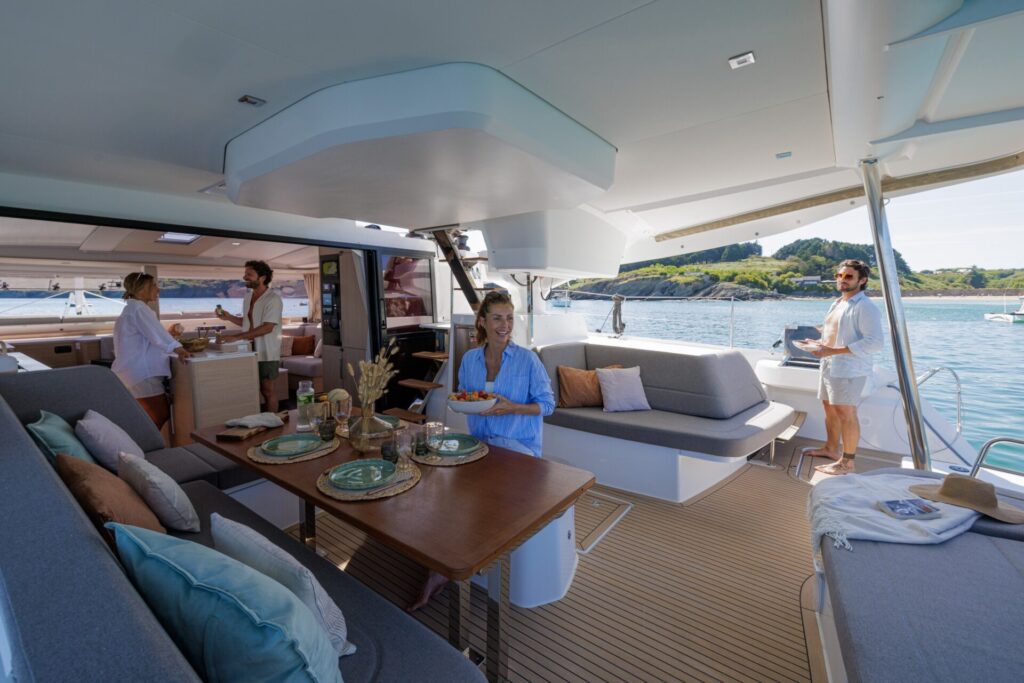
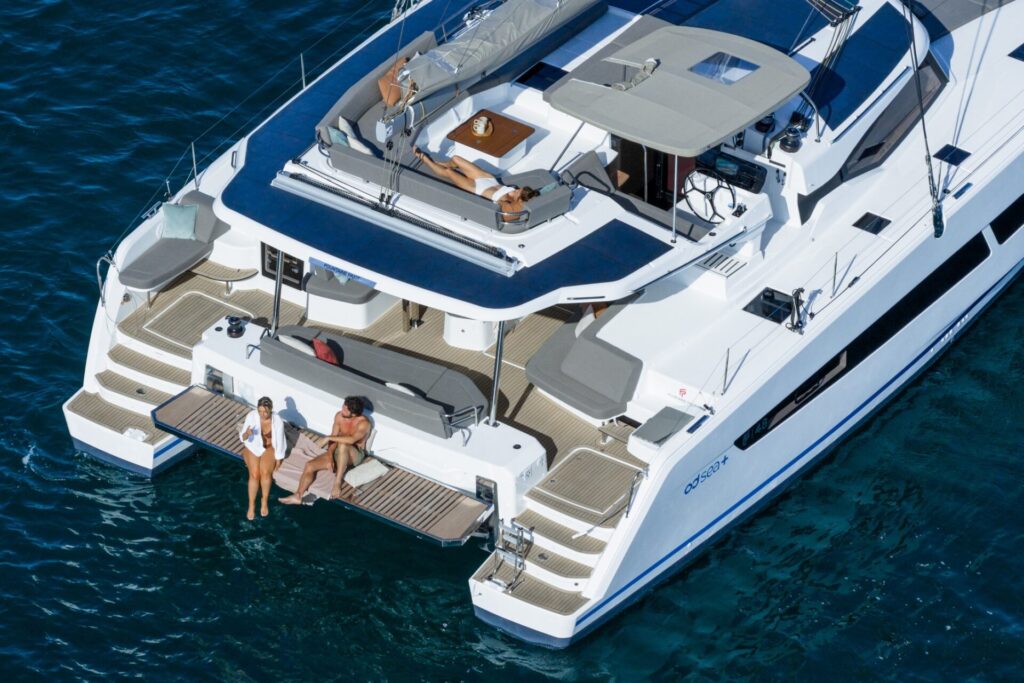
The cockpit is often where a day aboard begins and ends. Here, you will find more room with a friendly atmosphere. There are several seating choices, including an aft lounger, so guests do not all have to gather around the same spot.
The cockpit table can seat up to 12 guests. You may not need that capacity every evening, but anyone who has invited a neighbouring crew aboard will understand its appeal.
A forward cockpit and a lounge deck to relax
At the bow, the forward cockpit offers another outdoor area, while the lounge deck gives guests an elevated space to relax. You may see this upper area described as a flybridge. It should not be confused with a full flybridge carrying the helm station: the steering arrangement remains connected to the cockpit below.
An open saloon with a practical galley
A wide sliding glass door connects the interior saloon and cockpit. Rather than treating them as separate rooms, the layout lets daily life flow between them. Inside, panoramic windows and headroom reaching 2.20 m add to the feeling of space, without relying on complicated styling.
The galley runs along the port side and works with a central island. This becomes a natural meeting point for preparing food or talking over the day’s plans. A conventional saloon table is optional, so it is worth considering how you prefer to eat, work and spend time inside.
An owner’s suite with independent deck access
The Maestro layout owner’s suite in the port hull offers great privacy. It includes a generous bed, a forward office area, and a private bathroom with a shower and a separate head. A door opens directly onto the deck, bringing daylight, ventilation and independent access while at anchor. It is an unusual feature, and one that deserves a proper visit rather than a quick glance at a layout drawing.
The guest cabins at starboard also have great dimensions, and a private bathroom with shower. Crew cabins in the forepeaks can be fitted as an option.
More broadly, the magazine’s account suggests that comfort comes from several details working together, not simply from increasing the beam. Among the features that stand out are:
- A smoother connection between indoor and outdoor living.
- Wide side-decks for moving forward.
- Generous accommodation for owners and guests.
- Separate outdoor zones for conversation or quiet time.
A cruising catamaran that is easy to handle
Extra comfort comes with a compromise. There is an increase in displacement over the previous model. This is a catamaran designed for cruising, not racing, and it is better to say that plainly than to promise everything at once.
However, the changes below the water are important too. Fountaine Pajot has redesigned the hull shapes and increased keel depth to 1.64 m. These changes are intended to improve efficiency under sail and upwind course-keeping. They are less visible than a new window, but deserve just as much attention.
A helm station that keeps the crew connected
The combined steering and sail-handling arrangement at starboard, with one position behind the other, is characteristic of the shipyard. Controls are accessible, and visibility towards the sails and bows is good. On a boat of this size, that can make a meaningful difference when sailing short-handed.
Just as importantly, the helm remains connected with both the cockpit and the upper deck. Whoever is steering is still part of life aboard. We like that idea: a passage should be something to share, not a day when one person disappears to a separate level.
Encouraging results in light wind
Multihulls World reported four knots of boat speed in six knots of wind. The reviewer was pleasantly surprised by its ability to sail, keep going and tack without using the motors. Encouraging observations, certainly, but not a promise of the same result on every passage.
ODSea+, solar energy and a different way to cruise
The yacht tested by Multihulls World carried two electric motors, batteries, solar panels and a generator as part of its optional hybrid power installation. Our introduction to ODSeaLab and eco-navigation explains the thinking behind these energy developments. The system should not be confused with the standard propulsion specification.
Solar capacity on the reviewed installation reached 2.8 kWp. Solar production can contribute to energy needs, but available power and range depend on conditions and use. There is no need to turn this into a claim of complete independence: the interesting question is how the whole system supports the way you actually cruise.
A small electric boost when the wind drops
In the light breeze, the Multihulls World reviewer found that a small amount of motor assistance helped the boat gain speed and build apparent wind, allowing the sails to work better again. This is perhaps the most interesting part of the test. Rather than simply replacing a diesel engine, the hybrid option offers another way to manage those slow summer passages when you still want to sail.
Vote for the FP48 before 7 November
For us, the appeal is not a dramatic break with everything that came before. It is the patient improvement of a cruising boat: better circulation, more comfortable accommodation and thoughtful handling. Fountaine Pajot has kept a familiar character while developing the details that shape everyday life aboard.
If that approach speaks to you too, please vote for the FP48 in the British Yachting Awards 2026. The deadline is 7 November. To take part:
- Open the British Yachting Awards voting page.
- Under Multihull Yacht of the Year, select Fountaine Pajot 48
- At the bottom of the page, fill in your name, email, and select your country of residence and submit. That’s it!